Jetsons House | Construction Documents (CD phase)

The architectural design phase for completing a project is divided into percentages of time for the total work. Usually Schematic Design (10–25%), Design Development (15–25%), Construction Documents (35–45%), Bidding (5–10%), and Construction Administration (20–30%).
In our Architecture office, the phases from design to construction have somewhat of a different span than in a traditional practice. This is due to the time we take doing research and the structured thought process to get the initial concept “correct.” For our firm, “correct” is based on our intrinsic beliefs and our vision of architecture as art.times of the day, either from my home, school, or walking around town. The sound marked the hour for prayer, work, and community gatherings.

From the beginning, we consider our projects as artistic endeavors deeply rooted in the DNA of our Development Group. There is no way for us to start the Design Development and Construction Documentation phases without having a clear vision of what the actual geography, historical context, and the Zeitgeist is calling us to build. We use 3D modeling to create multiple schematic models, which means for us, the Design Intent phase takes longer. This process by default shortens the Design Development and Construction Drawing Documentation Phase.
The Schematic Design phase of The Jetsons House took quite a long time — about 25% — delaying the project. However, it should be said that art cannot be rushed. To make an addition to this iconic house, which is documented in university libraries, publications, and media, and is a beautiful example of MIMO (Miami Modern architecture of mid century), we needed a longer thought and decision process.

In architecture, the parti refers to the fundamental concept of an architectural design, often represented by a diagram but in our case it’s a rough, schematic 3D model that shows the core idea that will drive the overall design of the house. After many failed attempts we achieved our sought after model-parti and moved comfortably into Design Development. This is the phase where we take the Schematic 3D model and using BIM, we refine it by specifying materials, window and door locations, and structural details. Additionally, we lay out mechanical, electrical, plumbing, structural, and other architectural details. In our office, the Design Development phase very nearly merges with the Construction Documentation phase. For The Jetsons House the DD took 30%.
We then moved into Construction Documents with a fairly precise 3D model. We have found many engineers prefer working with a 2D software such as Autocad. The mark we use for actually moving into Construction Documents is the day we export our 3D model into 2D documents. For me it’s a sad day because, in a way, I feel we lose some control of the process. It is similar to sending my baby to school, where there will be less of my influence. He/she will now be influenced by others as well.

Once our design has been handed to the engineers, we schedule regular meetings to monitor how their systems interact with our architecture. The drawings will include all pertinent information required for the contractor to price and build the project, like specifications for construction details and materials. The level of detail in CDs may vary depending on the project. For The Jetsons House we made sure to analyze all details regarding the connections between the old house and the new construction.
In my last blog I spoke about how I landed on the vision for The Jetsons House. I imagined a spaceship-car coming down from the skies and parking next to the existing house. In that spot a new wing will house the master bedroom and third floor terrace, and below it, the ground floor terrace. The new wing intersects the existing structure and the exact points where they will touch presented structural and architectural challenges.
The building code and actual structure of the house present physical limitations, not philosophical ones. In the Construction Documentation phase, philosophy or history do not matter anymore. This is a mathematical, pragmatic, physics phase. We need to make sure the structure is sound and it passes code inspections, which in Miami are very stringent. The strict codes are mainly due to the effects of hurricane wind forces, nearly year-round heavy rainfall, and extremely high humidity (which speeds deterioration of materials and equipment).

The CD phase for The Jetsons House took 22%.
We will go more into detail later about the most challenging parts of building this house. But for now let’s just say that once we were satisfied with the CD’s, Raphael J Hillis, our junior partner, sent them to the contractors we had preselected for final bidding. It is important to note that many of our contractors had already met with us and seen the project since we wanted their input before finalizing the drawings completely.
The contractors then sent the final estimates of project costs. We met one more time to clarify any doubts (if some systems were priced too high, like the oversized air conditioning units), we made changes in the drawings where necessary, and finalized them for permitting. The bidding phase took 3%.
Next it goes to the city’s hands. I have mixed feelings in this transition as well. On one hand we feel the thrill of being able to break ground as soon as we get the permits, but we intensely feel the lack of control. And on a side note, in my view, the city takes too long for approvals, even when we use expeditors. The process can take from 6 months to a year or even more depending on the complexity of the project. It is important to note we needed to present multiple 3D views of the project in order for the reviewers to understand the 2D plans. The Jetsons House was VERY different from most structures the city is accustomed to approving.
Permitting
Given the complexity of what we were doing, the city of Miami was surprisingly reasonable. It took several back and forths between our junior partner, Raphael J Hillis, the city, and the engineers for everyone to be on the same page. Luckily, while the house has a lot of historic value and is “iconic” it was not designated as historic. This allowed us to skip the Historic and Environmental Preservation Department entirely, saving at least 6 months in permitting time.
There were only two complex issues that took time and in-depth code review to resolve:

Height and terrace waver: including the third floor balcony, our addition to the existing Jetsons House technically had three floors. This is not allowed in Miami’s residential T-3 single family zoned neighborhoods. The “third floor” (which really is just a terrace on top of the second floor) required a waiver. It was obtained by getting approval from the city (they understood what we were doing) and then mailing a “notice” to all of the neighbors within a certain radius of the property. Thankfully, none of the neighbors objected so the terrace was approved. Also, the addition’s height is slightly higher than typically allowed in the neighborhood due to the “fin” on the top part of the house. We had to go through a similar process, but it was also approved.
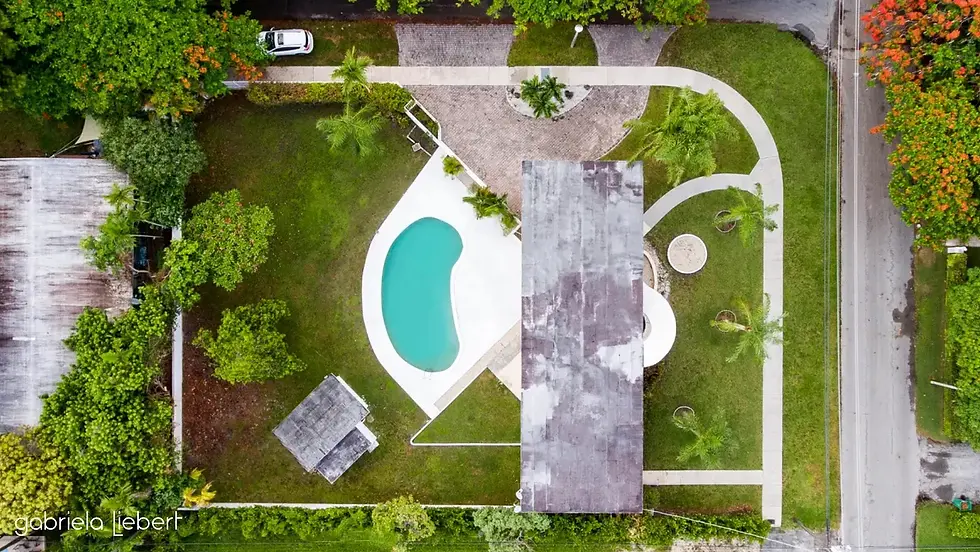
Lot separation: when the property was purchased it sat on two lots, one for the house, and one for the pool and yard. We wanted to separate them and sell the pool/yard lot. However, the original pool sat directly on the lot line, so the pool had to be demolished and filled in. But then another issue appeared: the secondary lot’s legal description stated it was less than one full lot. This could have been an issue, because the city of Miami does not allow you to build a house on less than one full lot. We were initially concerned, and thought we might have to re-platt, a process that can take up to two years. Research revealed an exception in the code that allowed us to proceed with the separation and for the secondary buyer to build on the lot.
Both processes took a little over 1 year. It was a very long time considering we have permitted other projects in 6 months or less.
Main participants of this phase: Gabriela Liebert Architect, Home Vision DNA Design Team, Raphael J Hillis junior partner, Village Architects and Engineers Team.


Comments